The universal map is ready to fill in yourself. The personalized map arrives with your baby's calendar dates already added. The kit contains three ready-made PDFs.
The development windows organize broad age-based guidance. They do not predict when an individual baby will be fussy.
For any baby, including babies born early
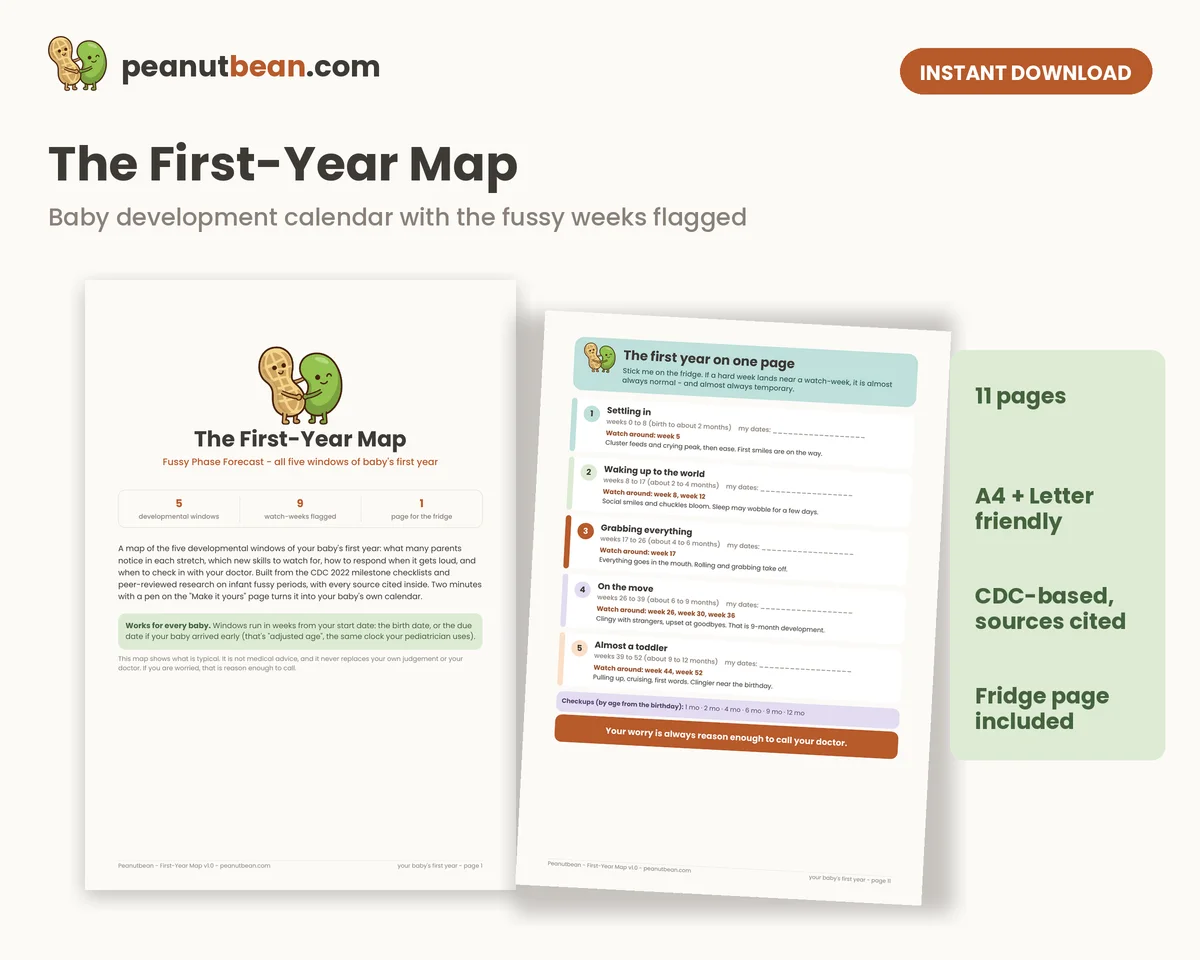
The First-Year Map
A fill-in map for parents who want the whole first year on paper.
11 pages with five development windows and nine rough research landmarks
CDC milestone checklists for 2, 4, 6, 9 and 12 months
Prices are in US dollars. Taxes may be added or included by the sales platform, depending on your location.
Universal or personalized?
Choose The First-Year Map if you are happy to add dates with a pen. It has the five development windows, milestone checklists and a fridge page.
Choose Your Baby's First-Year Map if you want the dates calculated and placed throughout the PDF. It also accounts for adjusted age when a baby was born early.
What is in the complete kit?
The Complete Peanutbean Kit contains exactly these three ready-made PDFs:
The First-Year Map
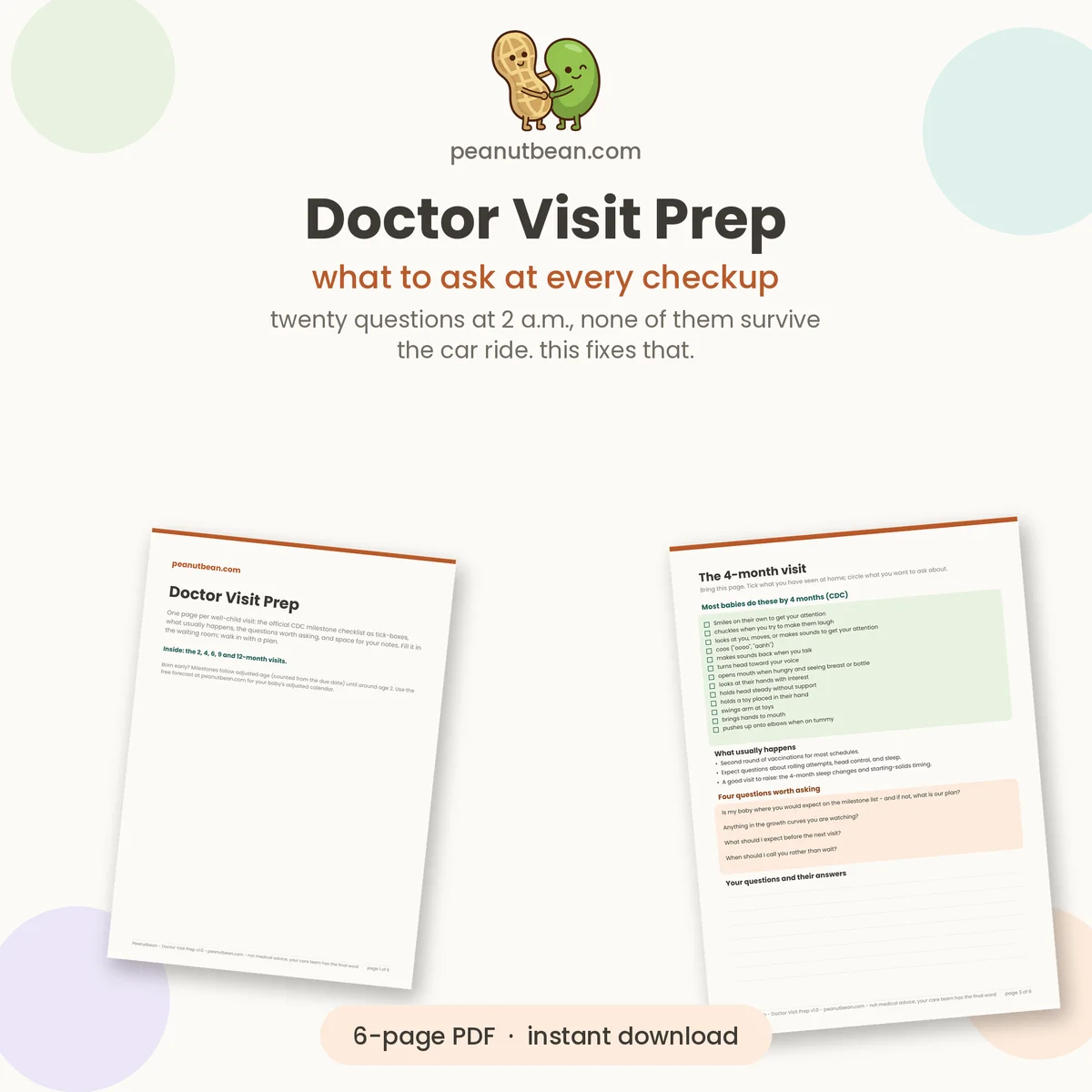
Doctor Visit Prep
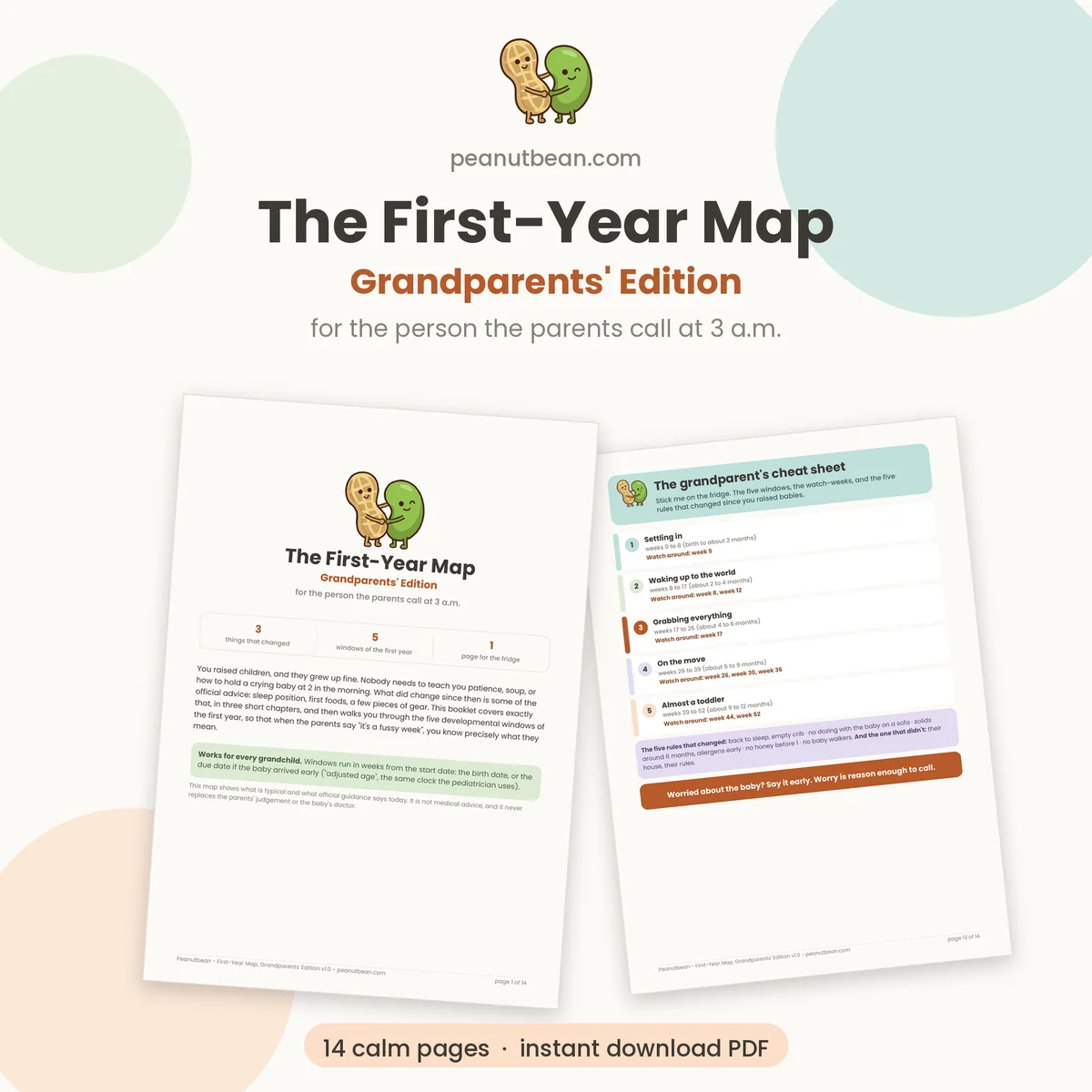
The First-Year Map, Grandparents' Edition
The personalized map is not part of this kit.
Questions before you buy
Are these physical products?
No. Every product on this page is a digital PDF. Nothing is shipped.
How are the files delivered?
The ready-made guides are instant Gumroad downloads. The personalized map is made for you and emailed within 24 hours.
Can I print them at home?
The universal map, grandparents' edition, Doctor Visit Prep and complete kit are designed for A4 and US Letter paper.
What do you need for personalization?
Gumroad asks for your baby's name, birth date, due date if relevant, and pronouns. The due date lets us use adjusted age for a baby born early.
Not sure which guide you need?
The on-screen forecast is free and does not require signup.
Peanutbean provides general information for educational purposes only. It is not medical advice.
Every baby develops at their own pace. Always talk to your pediatrician about your child's health.
What's going on?
Struggling to breathe, blue or grey lips, a seizure, or unresponsive?
Call your local emergency service now. Do not keep browsing.
Won't stop crying
Start with the basic checks: feeding, nappy, temperature, clothing, and anything that could hurt. If the cry sounds unusual, your baby is hard to wake, or breathing looks different, get medical help. If you feel overwhelmed, put the baby on their back in a safe cot and step away for a few minutes.
Quick orientation only. The full guide explains the warning signs and links its sources.
38C / 100.4F or higher is a fever. If your baby is under 3 months, call a medical professional now. At any age, get urgent help if your baby is hard to wake, struggling to breathe, having a seizure, or looks blue or grey.
Quick orientation only. The full guide explains the warning signs and links its sources.
Frequent night waking is common in the first year and does not mean you have caused a problem. For every sleep, place your baby on their back on a firm, flat, separate sleep surface with no pillows, bumpers or loose bedding.
Quick orientation only. The full guide explains the warning signs and links its sources.
Spitting up after feeds is common. Get medical help promptly if vomit is green or bloody, vomiting is repeatedly forceful, your baby struggles to breathe, feeds poorly, or has noticeably fewer wet nappies.
Quick orientation only. The full guide explains the warning signs and links its sources.
Many baby rashes are mild, but a rash needs prompt medical attention if your baby also has a fever, feeds poorly, is hard to wake, or seems very unwell. Call emergency services if there is trouble breathing or swelling around the lips or tongue.
Quick orientation only. The full guide explains the warning signs and links its sources.
A red face and straining do not mean constipation if the poo is soft. Hard, dry poo is different. Contact a medical professional if your baby is very young, feeds poorly, vomits, has blood in the stool, or has a swollen tummy.
Quick orientation only. The full guide explains the warning signs and links its sources.
Sore gums, drooling and chewing are common signs. Teething does not explain a fever of 38C / 100.4F or a baby who seems very unwell, so do not assume a new tooth is the cause.
Quick orientation only. The full guide explains the warning signs and links its sources.
A yellow tint in the first week is common. Get medical help promptly if it appears in the first 24 hours, or if your baby is hard to wake, feeds poorly, has dark pee or pale poo, or is becoming more yellow.
Quick orientation only. The full guide explains the warning signs and links its sources.
Put the baby on their back in a safe cot, leave the room for a few minutes, and ask another adult to take over if one is available. If you think you may hurt yourself or the baby, call your local emergency service now.
Quick orientation only. The full guide explains the warning signs and links its sources.
Wanting to be held is common in young babies. Contact sleep is only safe while the adult stays awake. Never fall asleep holding a baby on a sofa or chair. For sleep, use a firm, flat, separate surface and place the baby on their back.
Quick orientation only. The full guide explains the warning signs and links its sources.
A repeated fussy stretch in the evening is common in young babies, but the pattern is not a diagnosis. Get medical help if there is a fever, breathing looks different, your baby is hard to wake, or feeding has changed sharply.
Quick orientation only. The full guide explains the warning signs and links its sources.
Newborns can grunt and squirm during active sleep. Get urgent help if grunting happens with every breath, the ribs pull in, lips look blue or grey, there is a fever, or your baby is hard to wake.
Quick orientation only. The full guide explains the warning signs and links its sources.